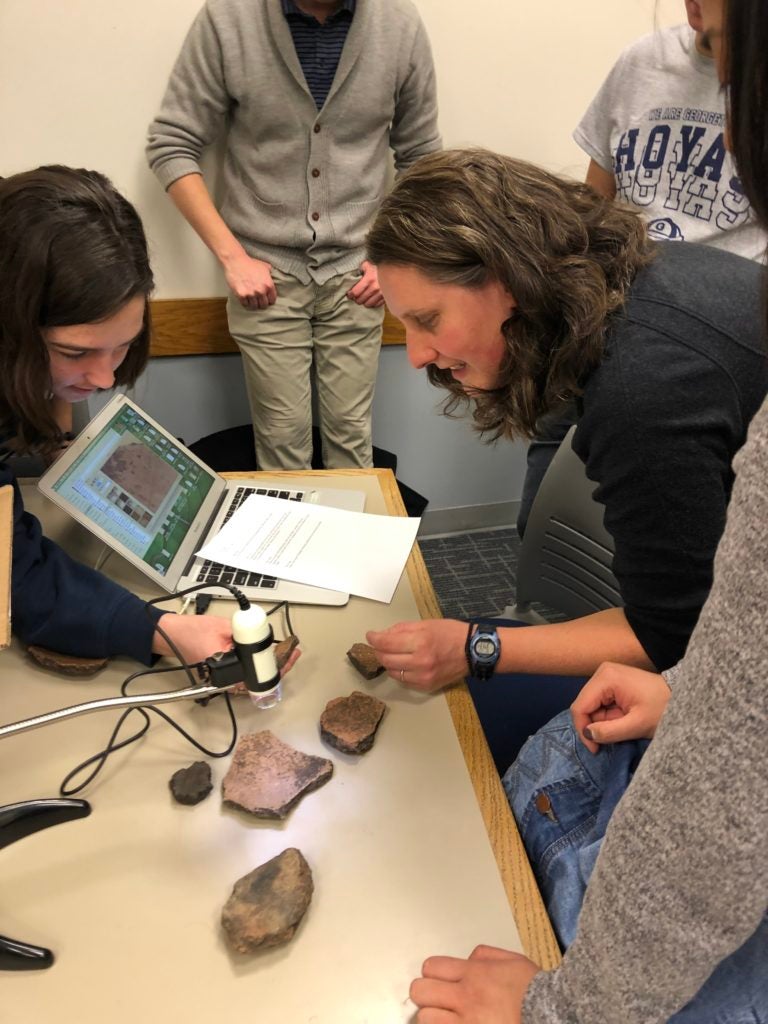
The 30-credit Master of Arts in Engaged & Public Humanities degree requires completion of four core courses, four electives, six credits of experiential learning through either an internship or a public humanities report and a capstone project. You’ll graduate with a foundation grounded in both theory and hands-on experience.
Core courses
You’ll gain a solid foundation in the public humanities through our four core courses worth 12 credits.
This course is an introductory, cohort-shaping proseminar that introduces you to the core theories, methods, ethical questions and practices of the engaged and public humanities, an emergent discipline with a long history that is only now beginning to be recognized. We will trace that history and a wide variety of related subjects by employing methods and methodologies developed in the humanities and humanistic social sciences. Our primary goal in this course is to grow as and into scholar-practitioners who are reflective about our roles, responsive to the needs of our communities, responsible and accountable for the impacts of our decisions and receptive to the many possibilities, challenges and rewards of work in the engaged and public humanities.
This course focuses on doing many of the most important kinds of writing and communicating that you will use in your career in the engaged and public humanities. Ranging from advertising copy to infographics to web content to grants, the course’s activities will familiarize you with the primary modes of communication in the contemporary nonprofit world. It will also introduce some of the methods of improving (“optimizing”) your copy and graphics for better outreach to target audiences through techniques such as search engine optimization (SEO), A/B testing and heat mapping. The aim of the course is not to build expertise in any single area of nonprofit communication, but to equip you to recognize the differences between these modes and when you need to grow in an area, how to look for models of good practice and how to emulate those models.
This course introduces the institutional structures, including government, media, museums and both non-profit and profit-driven entities, in which humanities graduates are employed. You will explore where the humanities intersect with professional practice and public life, but also where fissures persist between our understanding of the humanities and the arts and their purpose in contributing to the common good. Every week, a guest speaker with a background in the humanities will share insights into their line of work and provide details from their own career trajectories. The course allows you to pursue research into a particular institution, business or non-humanities discipline and its relationship to the humanities. Throughout the semester, you will be asked to conduct informational interviews, create job materials and present either a review of an industry of your choosing or an intellectual autobiography detailing your personal, intellectual and professional commitments.
This course covers the main areas of what we call Digital Humanities (DH) today:
DH as a research tool
DH as a driver of pedagogical innovation
DH as the agent of social change
DH as itself an ontological register for expressive work open to humanities study
DH as the shorthand for non-print-based, alternative media platforms for the production of knowledge.
You will develop an understanding of the debates that currently drive growth in this field through reading theory as well as analyzing current applications and then develop a digital project of your own related to your larger program goals.
Skills you’ll develop
Digital theory
Pedagogical innovation
Research
Internship
To apply what you learn in a professional context, you’ll complete a mentored internship. If you’ve already worked or are working in the field, you have the option to complete a public humanities report instead.
Your capstone project is the culminating experience of the program. You’ll integrate what you’ve learned in the program with the experience you gained either in your internship or reflected on in your public humanities report.
To earn the degree, you will take four elective courses, which should be tailored to your area of interest. You can choose from graduate courses or upper-level undergraduate courses adjusted for graduate credit. Electives can be taken either within your discipline or an interdisciplinary field, with approval from the department and instructor, and can include independent studies and tutorials.
You can choose from the wide range of courses offered at Georgetown University. From classics to art history topics to philosophy courses covering bioethics, political philosophy and other relevant subjects, you’ll find many opportunities to apply the humanities.
Some of the electives that the Engaged & Public Humanities students have taken include:
Take part in academic discovery, community engagement and personal growth through our Master of Arts in Engaged & Public Humanities to create a future where the humanities are at the forefront of social transformation.